

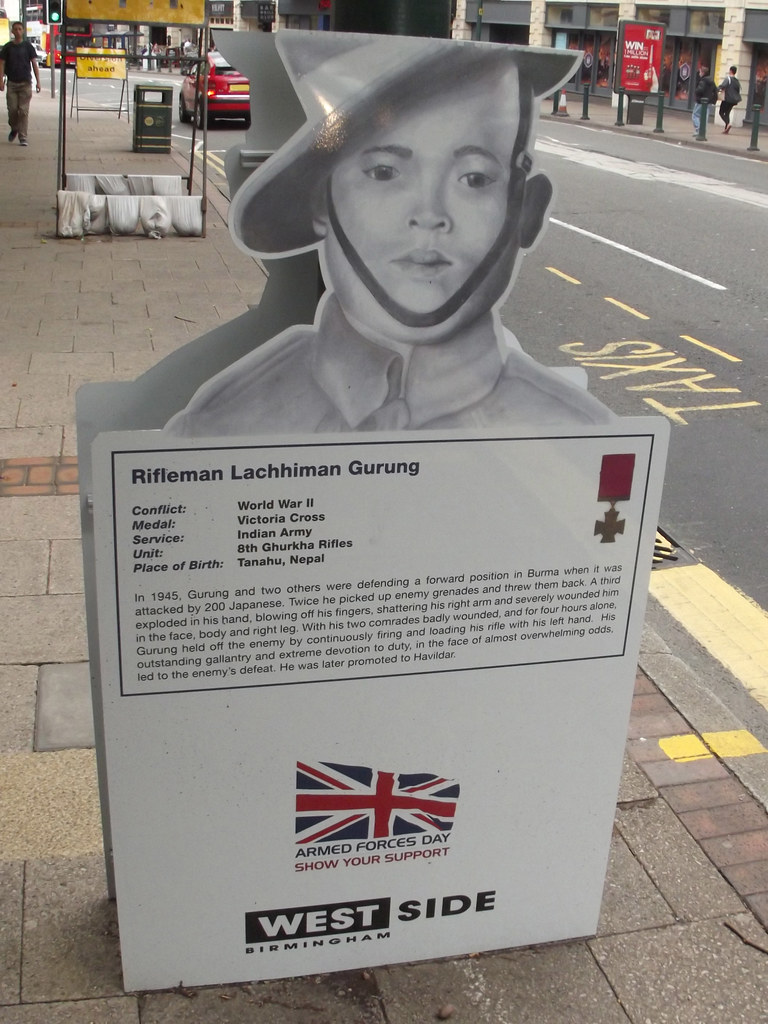
A grenade landed on the lip of Lachhiman Gurung's trench, and he threw it back. A second dropped inside, and he threw that back too. The third went off in his right hand.
This was shortly after midnight on 13 May 1945 at Taungdaw, Burma. Gurung, a rifleman in the 4th Battalion, 8th Gurkha Rifles, was manning the most forward post of his platoon. At least 200 enemy troops were assaulting the company's position.
The blast blew off his fingers and shattered his right arm. It wounded his face, body and right leg too. He would lose the sight in his right eye and the use of that hand for good.
He kept going. Regardless of his wounds, he fired and loaded his rifle with his left hand, in the words of his citation 'maintaining a continuous and steady rate of fire'. Try loading a rifle one-handed sometime. Actually, don't. Just take the medal's word for it.
He stayed at his post for four hours, firing into the attackers at point-blank range as each fresh wave arrived. The two comrades in the trench with him were wounded as well.
The legend says he took on 200 men with one hand, which is a tidy line but not quite the shape of it. Those 200 were attacking the whole company. The true arithmetic is still ridiculous: of the 87 enemy dead counted around the position, 31 lay in front of his section, which the citation called the key to the whole post.
He was presented with the Victoria Cross by the Viceroy, Lord Wavell, at the Red Fort in Delhi on 19 December 1945.
The odds had been against him long before Taungdaw. Gurung stood just 4ft 11in. In peacetime that was under the minimum height, and he would have been turned away. Wartime was short of men, so the Indian Army let him in during December 1940. The height rule, it turns out, was measuring the wrong thing.
Then came a quieter fight. He was born in Nepal in 1917 and went home there after the war. In 2008, aged 91, he was one of five claimants in a case over whether Gurkha veterans could settle in Britain. Joanna Lumley led a high-profile campaign alongside them, and the result was settlement rights for Gurkhas with four years or more of service.
Gurung settled in Hounslow that year. The Mayor and the Council held a ceremony to welcome him, and he was later made a Freeman of the borough. He died in London on 12 December 2010, aged 92.
So the man the peacetime rules would have turned away at the door spent his last years being formally welcomed by a London borough. It took the council rather longer than a trench full of grenades to find the right words.