

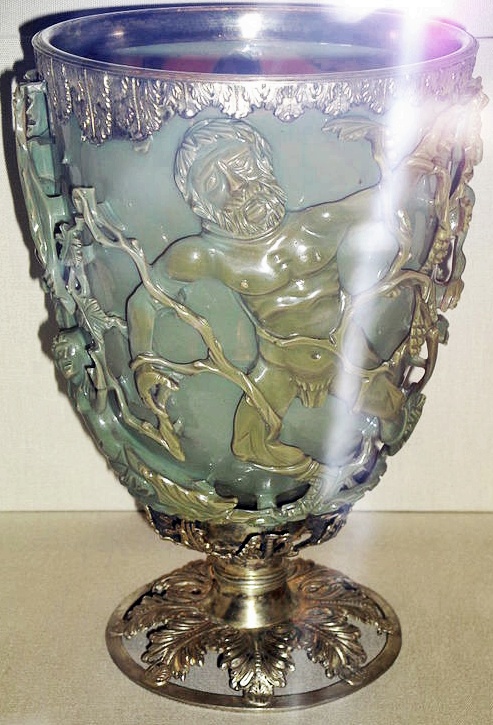
Hold the Lycurgus Cup in ordinary light and it looks jade green. Put a lamp behind it and it glows ruby red. A Roman glassmaker managed this in the fourth century, and the cup now sits in the British Museum, quietly outclassing most things in the building.
The obvious question is how, and why nobody pulled it off again for about 1,600 years.
The secret is gold and silver, ground down to particles each about a thousand times smaller than a grain of sand. When light shines through the glass, those particles block the blues and greens and let the reds and oranges through. Lisa Hollands, a technician at the University of Sheffield with more than 25 years of experience in glass, started from a recipe derived from a fragment of the original cup, then adjusted the amounts of gold and silver, the starting materials, the furnace and the oxygen levels until the glass cooled from over 1,000C and the colour came out.
Professor Caroline Jackson, an expert in Roman glass, advised on the ancient materials. Ian Freestone, emeritus professor of archaeological materials at University College London, looked at the result and said it came much closer to the original's shades than an attempt in the 1960s. He had no reason to be generous.
Which makes the likely truth of the original a little humbling. The effect is so difficult to control that experts believe the Romans almost certainly found it by accident. Nobody in the fourth century had the word nanoparticle. They had a furnace, some precious metal and, evidently, very good timing. Having stumbled on a colour-changing glass, they carved a cage of figures around it — Lycurgus, the mythical king, caught in the vines — which is a fairly confident thing to do with a happy accident.
The new recipe has already left the lab. Glass artist Elliot Walker has used it to make a contemporary piece, which goes on show at Sheffield's Millennium Gallery during the Festival of the Mind in November.
The original, in the British Museum, asks very little of its audience. No app, no audio guide, no explanation mounted on the wall. Just hold a torch behind it.